.png)

This post is inspired by The Business Times article “Cybersecurity hiring in Singapore surges with AI adoption, but talent gaps remain.” The Business Times
TL;DR: What You Need to Know
- Cybersecurity hiring in Singapore is surging, driven largely by AI, cloud and evolving digital risks.
- Demand spans far beyond coders; roles include analysts, SOC operators, incident responders and compliance.
- Many mid‑career switchers thrive without prior IT experience.
- Employers increasingly value practical skills over paper credentials.
- With structured, subsidised training available, a cybersecurity career is within reach.
If you're a mid‑career professional in Singapore, you may be feeling the pressure of automation, efficiency drives, or even AI encroaching on traditional job roles. Maybe you worry about stagnation, or being made redundant by smarter systems.
But what if your next move wasn’t just about staying relevant, but about stepping into one of the most secure, needed, and fastest‑growing fields in the country?
Contrary to some perceptions, the current surge in demand for cybersecurity talent in Singapore isn’t reserved for a small elite. It’s a broad, accessible opportunity open to problem‑solvers from many backgrounds, especially those with analytical, process‑oriented or people‑skills. This isn’t just a hiring trend; it’s a national priority. And you could be part of it.
Artificial intelligence has made companies smarter, faster, and more efficient but it has also made them more vulnerable.
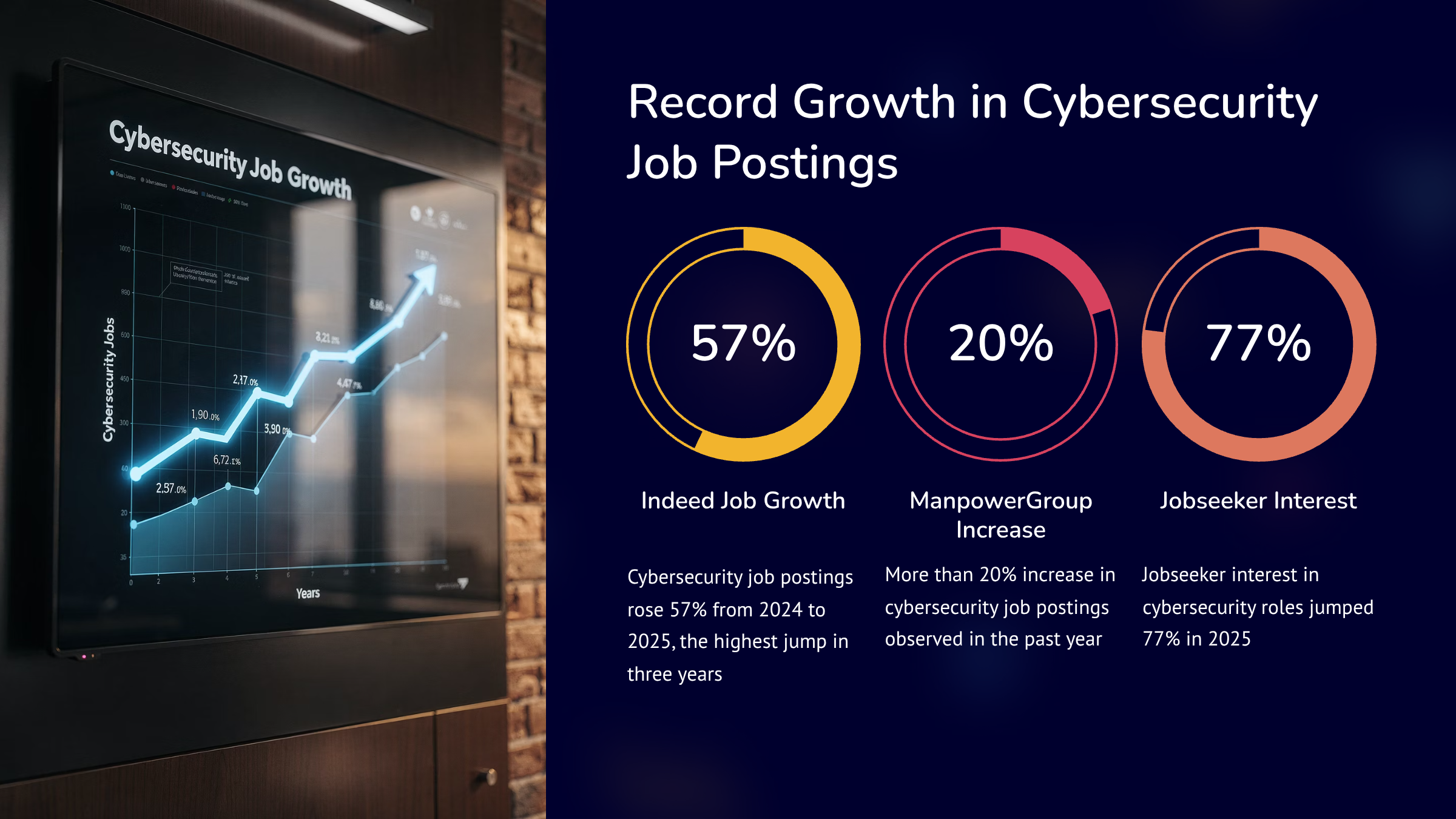
Recently, cybersecurity job postings in Singapore saw a 57 per cent jump between 2024 and 2025 the highest increase in three years.
According to a spokesperson from job‑site Indeed:
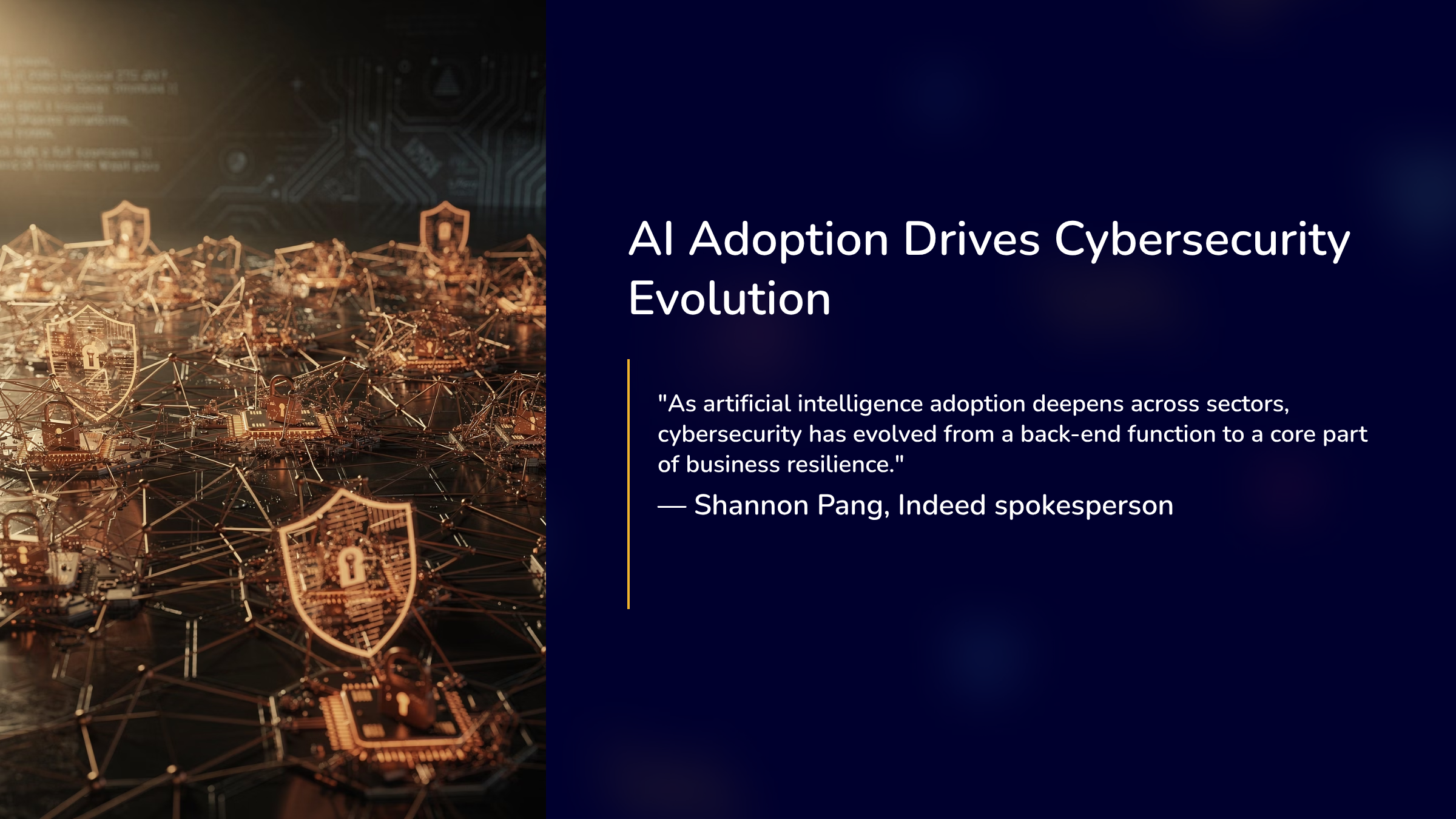
“As artificial intelligence adoption deepens across sectors, cybersecurity has evolved from a back‑end function to a core part of business resilience.” The Business Times
Why this sharp increase? Several forces are at play:
- AI increases attack surfaces. As firms adopt cloud, AI and data-driven systems at scale, every new integration chatbots, machine‑learning pipelines, automated decision‑making tools becomes a potential entry point for cyber threats.
- AI empowers attackers too. Cybercriminals increasingly use AI to automate phishing, craft deepfakes, or launch social engineering attacks, making threats more frequent and more sophisticated.
- More data means more risk. AI depends on data, sensitive customer information, business operations, proprietary algorithms. The more data flows through AI systems, the higher the cost of a breach.
- Regulation and compliance pressure. As firms deploy AI at enterprise scale, regulatory bodies and compliance frameworks (local and global) are tightening controls, increasing demand for specialists who understand how to secure AI data flows and ensure compliance.
- Distributed work expands threat perimeter. Remote work, hybrid setups, cloud‑based operations: these expand where and how people connect, adding complexity and creating new vulnerabilities that cyber teams must manage.
As one expert quoted in The Business Times put it:
“Companies are facing tighter regulatory requirements, and many are in the middle of major digital‑transformation or cloud‑migration projects. All of this has pushed cybersecurity from a back‑office function to something that needs real investment and attention.”
In short: AI has changed cybersecurity, not just by automating tasks, but by creating new kinds of risks. And with risk comes demand for those who can defend against them.
There’s a common idea that cybersecurity means hacker‑level coding, penetration testing, and deep technical prowess. But today’s demand is far broader. Many of the most-needed roles emphasise analytical thinking, communication, and disciplined processes, qualities where mid‑career professionals often already shine.
In Singapore, the surge in job postings covers a wide range of positions, including cloud security engineers, security operations centre (SOC) analysts, incident responders, governance, risk & compliance specialists, identity & access management experts, and more.
There is also growing demand for penetration testers and red‑teamers, as organisations begin stress‑testing their systems more seriously.
This shift matters because it opens the door for people from non‑traditional tech backgrounds. If you have strong analytical ability, attention to detail, process orientation, or prior experience in operations, compliance, support or project management, you could be a good fit.
Coming from a non‑IT background does not have to be a disadvantage. In fact, it can be a powerful advantage. Many of the skills you’ve honed such as communication, stakeholder management, documentation, escalation, process discipline are directly transferable to cybersecurity roles.
For example:
- Operations or customer support experience often involves triage handling issues, escalating appropriately, managing urgent requests. This is similar to the discipline needed by SOC analysts responding to security alerts.
- Project or compliance roles build strength in documentation, governance, cross‑team collaboration. These are key for incident reporting, audits, and compliance work in cyber teams.
At Centre For Cybersecurity (CFCI), as many as 74% of graduates who land cybersecurity jobs started with no IT background at all. And these graduates are thriving. We position our students' past experiences as crucial skills alongside their newfound technical cybersecurity skills when seeking employment in the cybersecurity industry.
One learner shared:
“This course made a career transition into cybersecurity not only possible but exciting, even without prior IT background.”
This shows that for many employers, soft skills and real‑world readiness count just as much as technical pedigree.
The talent shortage has become so acute that Singapore’s tech sector is increasingly embracing skills‑based hiring. While certifications remain useful, especially to get your CV through HR screening, they’re not enough on their own.
Certifications like GIAC Certified Incident Handler (GCIH) can signal baseline competence. But what truly wins offers is practical ability: can you investigate alerts, analyse logs, communicate findings clearly under pressure, and respond effectively during incidents?
That’s why hands‑on training matters. Courses like CFCI’s Cybersecurity Career Kickstart+ (CCK+) programme emphasise experiential learning:
- 28 real‑world cyber simulations
- 4 portfolio projects demonstrating your thinking and execution
- 24/7 cyber lab access for continuous practice
- Career support: resume prep, mock interviews, coaching
This hands‑on approach builds muscle memory, confidence, and, critically, a portfolio you can show potential employers. That practical proof often matters more than a wall of credentials.
A career change can feel overwhelming, especially when it comes to cost and time. But the path into cybersecurity doesn’t have to be long, expensive or disruptive.
With a focused, well‑structured programme, many mid‑career switchers can become job‑ready in 6 to 12 months. The course schedule is designed with working adults in mind (weeknight and weekend lessons), allowing you to continue working while you train.
Costs are also relatively modest after subsidies, a far cry from long degree programmes. And national initiatives and funding schemes often help offset the expense for Singapore Citizens and Permanent Residents.
For those who commit, the payoff can be fast. As one graduate put it:
“I would have never thought I could become a cybersecurity professional in just 6 months.”
Cybersecurity in Singapore isn’t an exclusive club for coders anymore. It’s a national priority and a field actively hungry for analytical, process‑oriented, and responsible professionals from many backgrounds.
That feeling of uncertainty about job security? It can become motivation to step into a role that protects not just your career, but Singapore’s digital future.
With a clear path to entry, practical training, growing demand, and strong support, there’s never been a better time to explore cybersecurity, especially if you’re ready to become part of building something meaningful and necessary.
Check next: Singapore's 2026 Shortage Occupation List: What It Really Means for Cybersecurity Careers
Thinking of Taking the First Step?
Attend a free Cybersecurity Experiential Workshop to try real‑world simulations and get a personalised skills report, no commitment required.
Or schedule a personal consultation to plan your next move.
Can I switch to cybersecurity without an IT background?
Yes. Many successful switchers began in education, customer service, operations or compliance.
How long does it take to become job‑ready?
With the right course and commitment, 6 to 12 months is realistic.
Are cybersecurity jobs stable in Singapore?
Yes. Demand continues to grow, especially with AI-driven risk and cloud adoption across industries.
What’s the minimum I need to learn to break in?
Fundamentals like networking, SOC operations, incident detection and response, and governance, all of which are covered in beginner-friendly cybersecurity courses in Singapore.
.png)
.png)

